
Velociraptor Facts
Pronunciation: veh-LOSS-ih-RAP-tor
Name meaning: Swift Thief
| Diet | Carnivore |
| Height | 0.5m |
| Length | 2m |
| Weight | 15 kg |
| Speed | 40 km/h |
| Environment | Land |
| Era | Cretaceous |
| Period | Late Cretaceous |
| Type | Theropod |
| Location | Mongolia And China |
| Diet | Carnivore |
| Height | 0.5m |
| Length | 2m |
| Weight | 15 kg |
| Speed | 40 km/h |
| Environment | Land |
| Era | Cretaceous |
| Period | Late Cretaceous |
| Type | Theropod |
| Location | Mongolia And China |
Velociraptor was a small but formidable theropod dinosaur that lived in Asia during the Late Cretaceous period, approximately 75 to 71 million years ago. Despite its fearsome reputation in popular culture, this swift predator was actually about the size of a large turkey, measuring roughly 2 metres long and standing just half a metre tall at the hip.
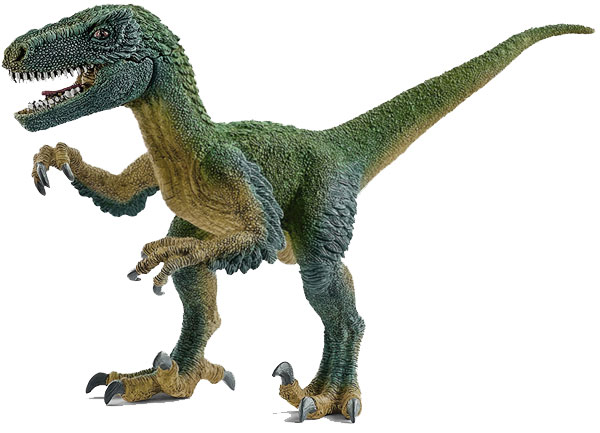
This theropod possessed several remarkable features that made it a highly effective hunter. Its most famous characteristic was the large, sickle-shaped claw on each foot, which could rotate through 180 degrees and was likely used to pin down prey or deliver fatal wounds. Velociraptor had long, powerful legs built for speed and agility, allowing it to chase down small mammals, reptiles, and possibly young dinosaurs across the arid landscapes of ancient Mongolia and China.
Recent fossil discoveries have revealed that Velociraptor was covered in feathers, though it could not fly. These feathers likely served purposes including temperature regulation, display, and possibly brooding eggs. The creature had excellent eyesight and a relatively large brain for its body size, suggesting it was an intelligent predator capable of complex hunting behaviours.
Velociraptor's lightweight build, sharp teeth, and grasping hands with curved claws made it perfectly adapted for its role as an active predator in the Late Cretaceous ecosystems of Asia, where it shared its environment with early mammals, lizards, and other dinosaurs including the famous Protoceratops.
Velociraptor is instantly recognisable by its large, curved sickle-shaped killing claw on each foot, which could be raised off the ground whilst running. It had a long, low skull filled with sharp, backwards-curved teeth, and a distinctive long, stiff tail that helped with balance during high-speed pursuits.
Velociraptor was likely an active, intelligent hunter that may have worked in coordinated groups to take down larger prey. Fossil evidence suggests it was capable of complex behaviours including brooding its eggs with feathered arms, similar to modern birds. Some specimens show evidence of scavenging behaviour as well as active hunting.
Velociraptor gained worldwide fame through the Jurassic Park films, though the movie versions were greatly oversized and based more on the larger Deinonychus. It continues to appear in numerous documentaries, video games, and children's books as one of the most recognisable dinosaurs.
Velociraptor was first described by Henry Fairfield Osborn in 1924. The original fossils were discovered at Djadochta Formation, Mongolia.