
Barapasaurus Facts
Pronunciation: BAR-ah-pa-SORE-us
Name meaning: Big leg lizard
| Diet | Herbivore |
| Height | 3.5m |
| Length | 14m |
| Weight | 8 tonnes |
| Environment | Land |
| Era | Jurassic |
| Period | Early Jurassic |
| Type | Sauropod |
| Location | India |
| Diet | Herbivore |
| Height | 3.5m |
| Length | 14m |
| Weight | 8 tonnes |
| Environment | Land |
| Era | Jurassic |
| Period | Early Jurassic |
| Type | Sauropod |
| Location | India |
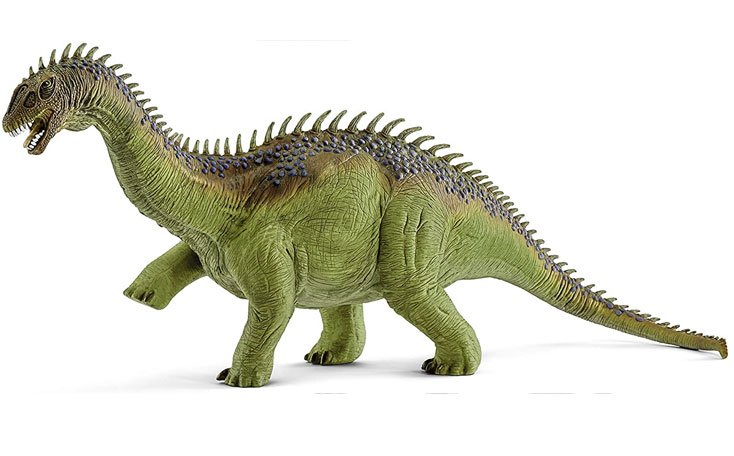
Barapasaurus was one of the earliest sauropods, living during the Early to Middle Jurassic period around 199 to 190 million years ago in what is now India. This impressive dinosaur measured approximately 14 metres in length and stood about 3.5 metres tall at the hip, making it a substantial herbivore for its time. Despite being an early member of the sauropod group, Barapasaurus already displayed many of the classic features that would make sauropods so successful, including a long neck, massive body, and pillar-like legs.
As a herbivore, Barapasaurus fed on the abundant plant life of the Jurassic period, using its long neck to reach vegetation at various heights. Its teeth were suited for stripping leaves and soft plant material, though like other sauropods, it likely swallowed stones to help grind up food in its stomach. The creature's robust build and powerful limbs suggest it was well-adapted to supporting its considerable weight whilst moving across the ancient landscapes of the Indian subcontinent.
What makes Barapasaurus particularly remarkable is the exceptional preservation of its remains. Discovered in the Kota Formation of Andhra Pradesh, India, this sauropod is known from approximately 300 bones representing at least six different individuals. This wealth of fossil material makes it one of the most completely known Early Jurassic sauropods, providing paleontologists with invaluable insights into the early evolution of these magnificent long-necked giants.
Barapasaurus had a relatively long neck for an early sauropod, robust limb bones that were particularly thick and sturdy, and a body plan that represented a transitional form between earlier prosauropods and later giant sauropods. Its vertebrae showed distinctive features that helped establish the early sauropod body plan.
Barapasaurus likely lived in herds, as evidenced by multiple individuals found together in the same rock formation. As a large herbivore, it would have spent much of its time feeding, using its long neck to browse vegetation at different levels whilst moving slowly across the landscape in search of suitable plant material.
| Phylum | Chordata |
| Class | Saurischia |
| Genus | Barapasaurus |
Barapasaurus was first described by Sohan Jain and colleagues in 1975. The original fossils were discovered at Kota Formation, Andhra Pradesh, India.