
Baryonyx Facts
Pronunciation: BARRY-oh-niks
Name meaning: Heavy Claw
| Diet | Piscivore |
| Height | 2.5m |
| Length | 7.5m |
| Weight | 1.2 tonnes |
| Speed | 25 km/h |
| Environment | Water |
| Era | Cretaceous |
| Period | Early Cretaceous |
| Type | Theropod |
| Location | England And Iberia |
| Diet | Piscivore |
| Height | 2.5m |
| Length | 7.5m |
| Weight | 1.2 tonnes |
| Speed | 25 km/h |
| Environment | Water |
| Era | Cretaceous |
| Period | Early Cretaceous |
| Type | Theropod |
| Location | England And Iberia |
Baryonyx was a remarkable fish-eating theropod that lived during the Early Cretaceous period, approximately 130-125 million years ago. This distinctive dinosaur roamed the river systems and wetlands of what is now southern England and parts of Iberia, making it one of the most significant dinosaur discoveries in British palaeontology.
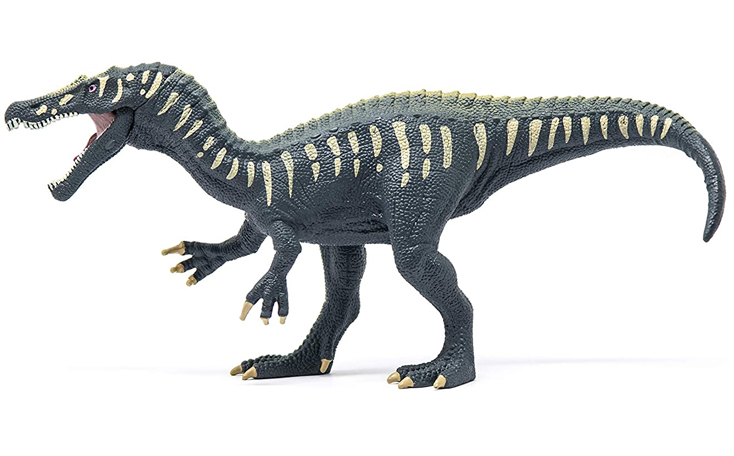
Standing about 2.5 metres tall at the hip and measuring up to 7.5 metres in length, Baryonyx was built for a semi-aquatic lifestyle. Its most striking feature was an enormous curved claw on each hand, measuring up to 31 centimetres long, which gave the dinosaur its name meaning 'heavy claw'. The skull was long and narrow, much like a modern crocodile, with approximately 96 small, sharp teeth perfectly adapted for gripping slippery fish.
Unlike most theropods, Baryonyx spent much of its time in and around water, using its powerful arms and massive claws to snatch fish from rivers and lakes. Its nostrils were positioned high on its snout, allowing it to keep most of its head submerged while hunting. The discovery of fish scales and bones in its stomach cavity provided direct evidence of its piscivorous diet, though it likely also scavenged other dinosaurs when the opportunity arose.
The original skeleton discovered in Surrey remains one of the most complete theropod fossils found in the UK, revolutionising our understanding of dinosaur diversity in Early Cretaceous Europe and proving that not all large theropods were purely terrestrial predators.
Baryonyx possessed enormous curved claws up to 31cm long on its hands, a long crocodile-like snout with 96 small sharp teeth, and nostrils positioned high on its skull. Its body was built for semi-aquatic life with powerful forearms and a relatively long, low skull compared to other theropods.
Baryonyx was primarily a fish-hunter that waded into rivers and lakes to catch prey using its massive claws and crocodile-like jaws. It likely stood in shallow water or along riverbanks, using its keen eyesight to spot fish before striking with lightning-fast precision, much like modern bears fishing for salmon.
Baryonyx has appeared in several video games including Jurassic World Evolution and ARK: Survival Evolved, and features in various dinosaur documentaries as an example of unusual theropod behaviour.
| Phylum | Chordata |
| Class | Saurischia |
| Family | Spinosauridae |
| Genus | Baryonyx |
Baryonyx was first described by Alan J. Charig and Angela C. Milner in 1986. The original fossils were discovered at Smokejack Clay Pit, Surrey, England.