
Diplodocus Facts
Pronunciation: dip-LOD-oh-kus
Name meaning: Double beam
| Diet | Herbivore |
| Height | 4m |
| Length | 27m |
| Weight | 15 tonnes |
| Speed | 15 km/h |
| Environment | Land |
| Era | Jurassic |
| Period | Late Jurassic |
| Type | Sauropod |
| Location | North America |
| Diet | Herbivore |
| Height | 4m |
| Length | 27m |
| Weight | 15 tonnes |
| Speed | 15 km/h |
| Environment | Land |
| Era | Jurassic |
| Period | Late Jurassic |
| Type | Sauropod |
| Location | North America |
Diplodocus was one of the most recognisable sauropod dinosaurs that roamed North America during the Late Jurassic period, approximately 158 to 149 million years ago. This magnificent herbivore was amongst the longest dinosaurs ever discovered, stretching up to 27 metres from nose to tail tip, though much of this impressive length came from its extraordinarily long neck and whip-like tail.
Living in the lush, semi-arid environments of what is now the western United States, Diplodocus shared its world with other famous dinosaurs like Allosaurus, Stegosaurus, and Brontosaurus. Despite its enormous length, this sauropod was relatively lightweight for its size, weighing around 15 tonnes. Its body was perfectly adapted for reaching high into ancient conifer trees to strip away needles and leaves with its pencil-like teeth.
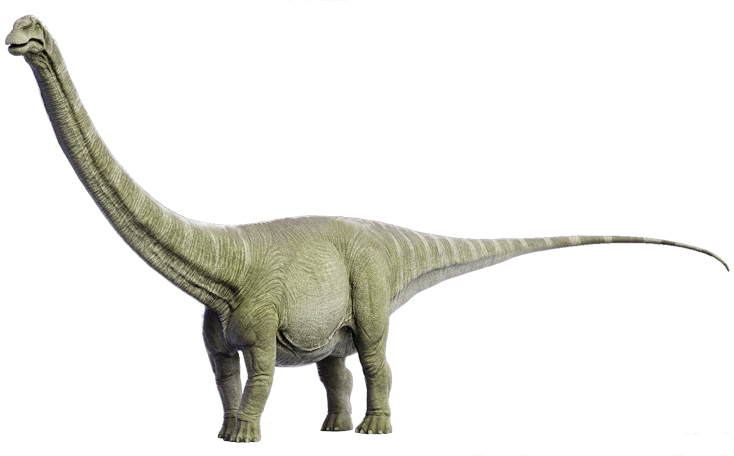
The distinctive features of Diplodocus included its incredibly long, flexible neck containing 15 vertebrae, and its even longer tail with over 80 vertebrae ending in a thin, whip-like structure. Its head was surprisingly small compared to its massive body, and its nostrils were positioned on top of its skull rather than at the front. The dinosaur walked on four pillar-like legs, with its front legs being shorter than its rear legs, giving it a distinctive sloping profile.
As a herbivore, Diplodocus used its long neck like a giant vacuum cleaner, sweeping from side to side to gather vegetation without having to move its massive body. Its unique double-beamed tail bones, called chevrons, gave this dinosaur its name and may have provided extra strength for using its tail as a defensive weapon against predators.
Diplodocus had an extraordinarily long, whip-like tail that made up more than half its total body length, and a remarkably long, flexible neck with 15 vertebrae. Its head was disproportionately small for its massive body, and it possessed distinctive double-beamed chevron bones underneath its tail vertebrae that gave the dinosaur its name.
Diplodocus likely lived in herds and used its incredibly long neck to browse vegetation at various heights without moving its body, much like a living vacuum cleaner. Scientists believe it could crack its whip-like tail like a bullwhip to create loud sonic booms, possibly for communication or defence against predators.
Diplodocus has appeared in numerous documentaries and films, including the BBC's Walking with Dinosaurs series, and a famous cast known as 'Dippy' was displayed in London's Natural History Museum for over a century.
| Phylum | Chordata |
| Class | Saurischia |
| Family | Diplodocidae |
| Genus | Diplodocus |
Diplodocus was first described by Othniel Charles Marsh in 1878. The original fossils were discovered at Morrison Formation, Colorado, USA.