
Styracosaurus Facts
Pronunciation: sty-RACK-oh-SORE-us
Name meaning: Spiked Lizard
| Diet | Herbivore |
| Height | 2m |
| Length | 5.5m |
| Weight | 2.7 tonnes |
| Speed | 25 km/h |
| Environment | Land |
| Era | Cretaceous |
| Period | Late Cretaceous |
| Type | Ceratopsian |
| Location | North America |
| Diet | Herbivore |
| Height | 2m |
| Length | 5.5m |
| Weight | 2.7 tonnes |
| Speed | 25 km/h |
| Environment | Land |
| Era | Cretaceous |
| Period | Late Cretaceous |
| Type | Ceratopsian |
| Location | North America |
Styracosaurus was a spectacular ceratopsian dinosaur that lived approximately 83.6 million years ago during the Late Cretaceous period in what is now North America. This impressive herbivore was roughly the size of a large rhinoceros, measuring about 5.5 metres long and standing 2 metres tall at the hip, with an estimated weight of around 2.7 tonnes.
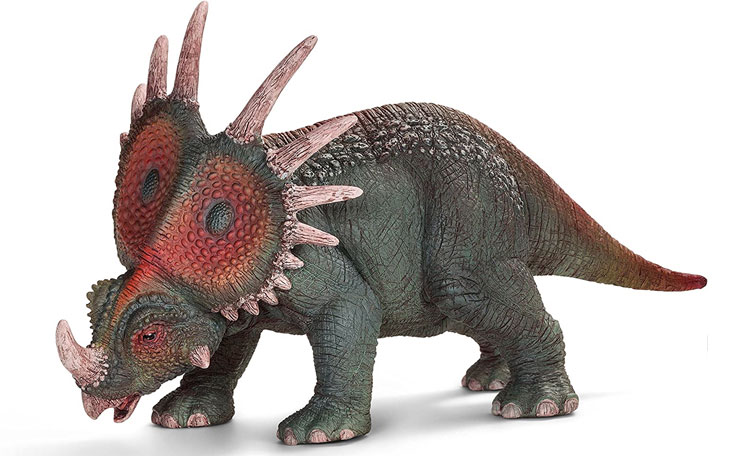
The most striking feature of Styracosaurus was its elaborate skull ornamentation. A massive horn, up to 60 centimetres long and 15 centimetres wide, projected from its nose like a formidable spike. Behind this, an impressive neck frill extended backwards, adorned with four to six long parietal spikes that could reach lengths of over half a metre. Smaller jugal horns protruded from each cheek, completing this fearsome display of spikes and horns.
As a herbivore, Styracosaurus used its sharp, parrot-like beak and rows of shearing teeth to slice through tough plant material including ferns, cycads, and conifers. Its powerful jaw muscles, anchored to the large frill, provided the strength needed to process fibrous vegetation. The dinosaur moved on four sturdy legs, with its front limbs slightly shorter than its back legs.
The function of Styracosaurus's impressive horns and frill remains debated amongst palaeontologists. These features may have served for defence against predators, species recognition, sexual display, or likely a combination of these purposes.
Styracosaurus is instantly recognisable by its enormous nose horn and distinctive neck frill decorated with four to six long spikes. The combination of its prominent facial horn, smaller cheek horns, and spike-adorned frill created one of the most elaborate head displays of any ceratopsian dinosaur.
Styracosaurus likely lived in herds, as suggested by bone beds containing multiple individuals found together. These ceratopsians probably used their impressive horn displays for social communication and intimidating rivals or predators, whilst their powerful build allowed them to charge at threats when necessary.
Styracosaurus has appeared in various dinosaur documentaries and children's books, often featured alongside other horned dinosaurs to showcase the diversity of ceratopsians.
Styracosaurus was first described by Lawrence Lambe in 1913. The original fossils were discovered at Dinosaur Park Formation, Alberta, Canada.