
Deinonychus Facts
Pronunciation: die-NON-ih-kus
Name meaning: Terrible Claw
| Diet | Carnivore |
| Height | 1.2m |
| Length | 3.4m |
| Weight | 73 kg |
| Speed | 40 km/h |
| Environment | Land |
| Era | Cretaceous |
| Period | Early Cretaceous |
| Type | Theropod |
| Location | North America |
| Diet | Carnivore |
| Height | 1.2m |
| Length | 3.4m |
| Weight | 73 kg |
| Speed | 40 km/h |
| Environment | Land |
| Era | Cretaceous |
| Period | Early Cretaceous |
| Type | Theropod |
| Location | North America |
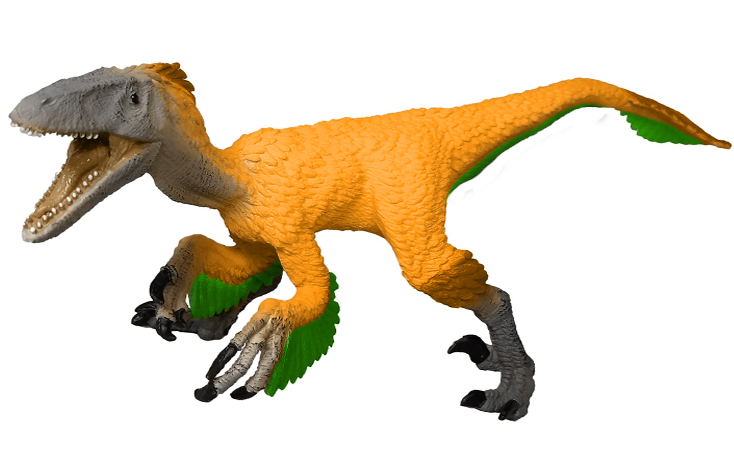
Deinonychus was a remarkable theropod dinosaur that revolutionised our understanding of dinosaur behaviour and biology. Living during the Early Cretaceous period, approximately 115 to 94 million years ago, this agile predator roamed the ancient landscapes of what is now the western United States. Standing about 1.2 metres tall at the hip and measuring up to 3.4 metres in length, Deinonychus was built for speed and precision hunting.
The most distinctive feature of Deinonychus was its massive, sickle-shaped claw on each foot's second toe, which could grow up to 13 centimetres long. This fearsome weapon was held off the ground whilst walking and could be flicked forward with devastating force to slash at prey. Its long, stiff tail acted as a counterbalance, allowing for exceptional agility during high-speed chases and quick turns.
As a carnivore, Deinonychus likely hunted in packs, targeting herbivorous dinosaurs much larger than itself. Evidence suggests it may have attacked the massive sauropod Tenontosaurus, demonstrating remarkable cooperative hunting strategies. The discovery of Deinonychus fossils alongside Tenontosaurus remains supports this theory of pack behaviour.
Perhaps most importantly, Deinonychus provided crucial evidence that dinosaurs were active, warm-blooded animals rather than sluggish reptiles. Its discovery sparked the 'Dinosaur Renaissance' of the 1970s and helped establish the evolutionary link between dinosaurs and modern birds, fundamentally changing palaeontology.
Deinonychus is instantly recognisable by its enormous, curved sickle claw on each hind foot, measuring up to 13 centimetres long. It had a long, rigid tail that made up more than half its body length, powerful hind legs built for running and jumping, and unusually large hands with three sharp claws each.
Deinonychus likely hunted in coordinated packs, using intelligence and teamwork to bring down prey much larger than themselves. Evidence suggests they may have been capable of leaping onto their victims, using their terrible claws to inflict fatal wounds whilst maintaining balance with their stiff tails.
Deinonychus was the primary inspiration for the Velociraptors in the Jurassic Park films, though the movie versions are much larger. It has appeared in numerous documentaries and dinosaur books as one of the most important dinosaur discoveries.
| Phylum | Chordata |
| Class | Saurischia |
| Order | Avetheropoda |
| Family | Dromaeosauridae |
| Genus | Deinonychus |
Deinonychus was first described by John Ostrom in 1964. The original fossils were discovered at Cloverly Formation, Montana, USA.