
Dilophosaurus Facts
Pronunciation: die-LOAF-oh-SORE-us
Name meaning: Two-crested lizard
| Diet | Carnivore |
| Height | 1.8m |
| Length | 7m |
| Weight | 400 kg |
| Speed | 30 km/h |
| Environment | Land |
| Era | Jurassic |
| Period | Early Jurassic |
| Type | Theropod |
| Location | North America |
| Diet | Carnivore |
| Height | 1.8m |
| Length | 7m |
| Weight | 400 kg |
| Speed | 30 km/h |
| Environment | Land |
| Era | Jurassic |
| Period | Early Jurassic |
| Type | Theropod |
| Location | North America |
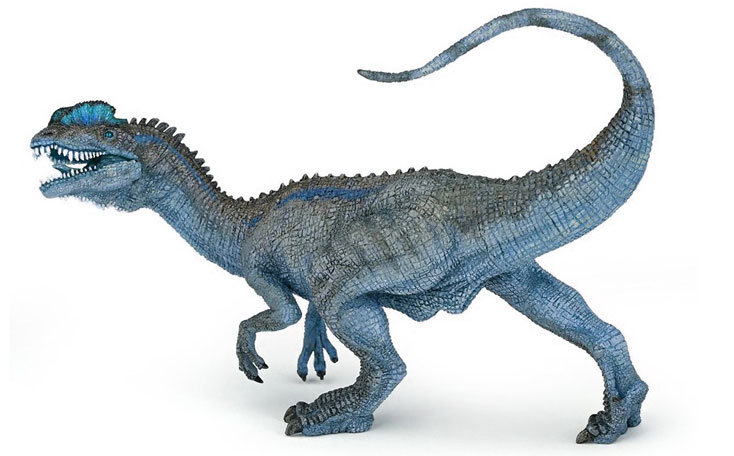
Dilophosaurus was a distinctive theropod dinosaur that roamed the landscapes of Early Jurassic North America around 190 million years ago. This impressive predator measured approximately 7 metres in length and stood about 1.8 metres tall at the hip, making it one of the largest predators of its time. What truly set Dilophosaurus apart were the two prominent, semi-circular crests that adorned the top of its skull, giving the dinosaur its name meaning 'two-crested lizard'.
As a theropod, Dilophosaurus was built for hunting, with powerful hind legs, sharp claws, and a mouth filled with pointed teeth. However, recent studies suggest its teeth were relatively weak compared to later theropods, indicating it may have been more of a scavenger or fish-eater rather than a bone-crushing predator. Its long, slender build and powerful legs suggest it was quite fast, possibly reaching speeds of up to 30 km/h when pursuing prey or fleeing from danger.
The first Dilophosaurus fossils were discovered in northern Arizona in the 1940s, though the distinctive crests weren't recognised until a more complete skeleton was found in 1964. Initially classified as a species of Megalosaurus, it wasn't until 1970 that palaeontologist Samuel Welles realised this dinosaur was unique enough to warrant its own genus. Since then, several specimens have been discovered, including juvenile fossils and even fossilised footprints that show evidence of the animal resting.
Dilophosaurus is instantly recognisable by the two distinctive, semi-circular crests running along the top of its skull, which were likely used for display rather than combat. It had a relatively slender build for a large theropod, with long legs adapted for speed and a narrow skull filled with sharp but delicate teeth.
Dilophosaurus likely lived and hunted in small groups, as suggested by trackway evidence showing multiple individuals moving together. The prominent crests on its skull were probably used for species recognition and display behaviours, possibly changing colour during mating seasons or territorial disputes. Its relatively weak bite force suggests it may have been an opportunistic feeder, scavenging carcasses or hunting smaller, easier prey.
Dilophosaurus gained fame as one of the antagonists in the 1993 film Jurassic Park, though the movie depicted it incorrectly as much smaller than reality and with fictional abilities like spitting poison.
| Phylum | Chordata |
| Class | Saurischia |
| Genus | Dilophosaurus |
Dilophosaurus was first described by Samuel P. Welles in 1954. The original fossils were discovered at Northern Arizona, USA.