
Utahraptor Facts
Pronunciation: YOO-tah-RAP-tor
Name meaning: Utah plunderer
| Diet | Carnivore |
| Height | 2m |
| Length | 7m |
| Weight | 700 kg |
| Speed | 40 km/h |
| Environment | Land |
| Era | Cretaceous |
| Period | Early Cretaceous |
| Type | Theropod |
| Location | United States |
| Diet | Carnivore |
| Height | 2m |
| Length | 7m |
| Weight | 700 kg |
| Speed | 40 km/h |
| Environment | Land |
| Era | Cretaceous |
| Period | Early Cretaceous |
| Type | Theropod |
| Location | United States |
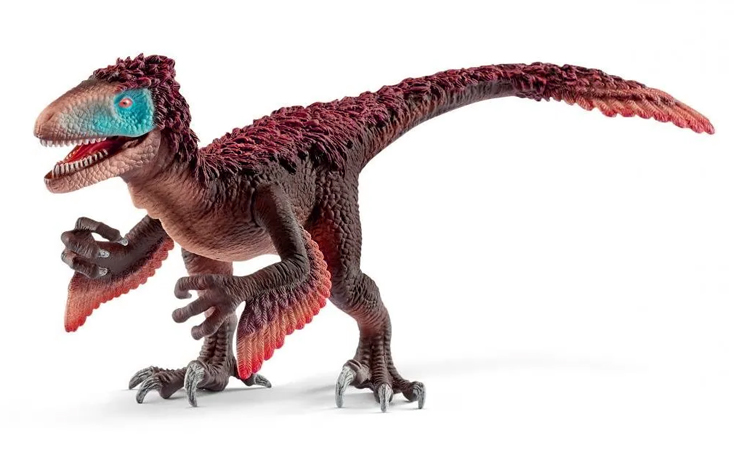
Utahraptor was a massive theropod dinosaur that lived during the Early Cretaceous period, approximately 139 to 135 million years ago, in what is now Utah, United States. This formidable predator was the largest known member of the raptor family, measuring up to 7 metres in length and standing 2 metres tall at the hip, weighing around 700 kilograms.
Like other theropods of its kind, Utahraptor was built for hunting, with powerful legs, sharp claws, and a relatively large brain. Its most distinctive feature was an enormous sickle-shaped claw on each foot, measuring up to 24 centimetres long. These fearsome talons could be rotated and were likely used to slash and grip prey during attacks. Utahraptor had a long, stiff tail that helped it balance whilst running and manoeuvring during hunts.
As a carnivore, Utahraptor would have hunted other dinosaurs, possibly working in coordinated packs to take down large herbivores such as iguanodonts. Its powerful build and deadly claws made it one of the most dangerous predators of its time. The dinosaur's body was likely covered in feathers, though these would have been for display and temperature regulation rather than flight, as Utahraptor was far too large to become airborne.
Fossils of Utahraptor were first discovered in the Cedar Mountain Formation of Utah and formally described by palaeontologist James Kirkland in 1993. Since then, additional specimens have provided valuable insights into both adult and juvenile individuals of this remarkable predator.
Utahraptor was distinguished by its massive size, being the largest known raptor dinosaur, and its enormous 24-centimetre sickle-shaped killing claws on each foot. It had a robust, muscular build with powerful legs, a long stiff tail for balance, and likely sported feathers across its body.
Utahraptor likely hunted in coordinated packs, using teamwork to bring down large herbivorous dinosaurs. It would have used its massive sickle claws to slash and grip prey, whilst its powerful legs allowed it to leap and maintain balance during attacks.
Utahraptor has appeared in various documentaries and video games, and its discovery influenced the portrayal of giant raptors in popular media following Jurassic Park.
Utahraptor was first described by James Kirkland in 1993. The original fossils were discovered at Cedar Mountain Formation, Utah, USA.