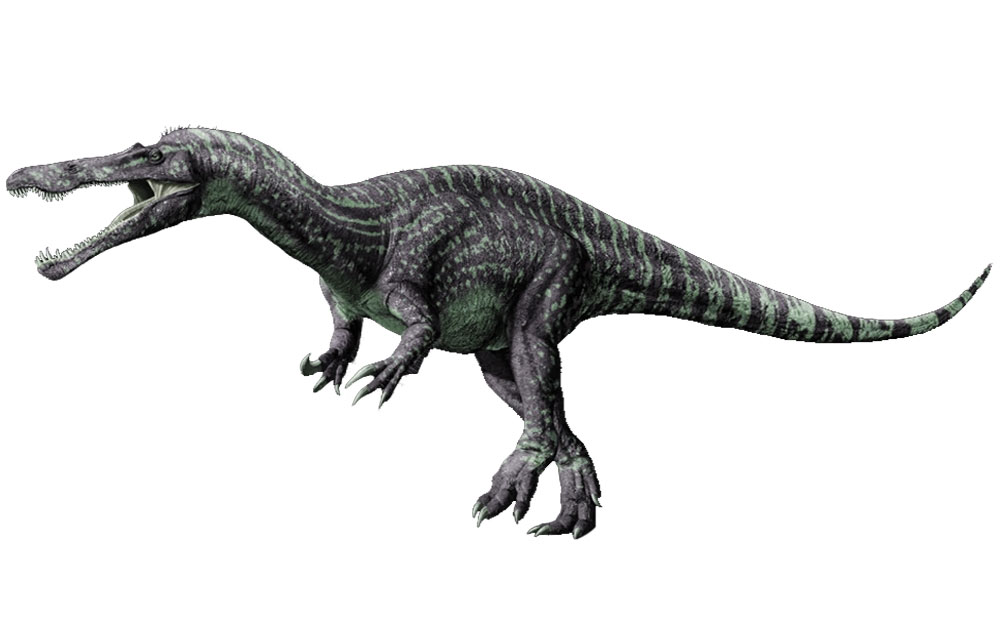
Suchomimus Facts
Pronunciation: SOOK-oh-MY-mus
Name meaning: Crocodile Mimic
| Diet | Piscivore |
| Height | 3.5m |
| Length | 11m |
| Weight | 4.5 tonnes |
| Speed | 25 km/h |
| Environment | Land |
| Era | Cretaceous |
| Period | Early Cretaceous |
| Type | Theropod |
| Location | Niger, Africa |
Suchomimus was a remarkable theropod dinosaur that lived 112 million years ago in what is now Niger, Africa, during the Early Cretaceous period. This impressive predator was one of the largest theropods of its time, measuring approximately 11 metres in length and standing 3.5 metres tall at the hip. Its name, meaning 'crocodile mimic', perfectly captures its most distinctive feature: an elongated, narrow skull remarkably similar to that of a modern crocodile.
This theropod was superbly adapted for a fish-eating lifestyle, with conical teeth perfect for gripping slippery prey and powerful claws for snatching fish from rivers and lakes. Suchomimus possessed a distinctive sail-like structure along its back, supported by elongated neural spines, though this was less pronounced than in its famous relative, Spinosaurus. Its forelimbs were particularly robust and well-developed, ending in large, curved claws that would have been formidable fishing tools.
Living in the lush, river-rich environment of Cretaceous Africa, Suchomimus inhabited a landscape teeming with fish, crocodiles, and other aquatic life. Unlike many theropods that relied purely on hunting land animals, this dinosaur had evolved specialised adaptations that allowed it to exploit aquatic food sources. Its discovery has provided paleontologists with one of the most complete pictures of any member of its family, offering invaluable insights into how these unique theropods lived and hunted.
What made Suchomimus distinctive?
Suchomimus had an extremely long, narrow skull resembling a crocodile's snout, filled with around 100 conical teeth ideal for catching fish. It possessed a low ridge or sail along its back, supported by elongated spines, and unusually large, powerful forelimbs ending in massive curved claws up to 30cm long.
Behaviour
Suchomimus likely spent much of its time near water sources, using its crocodile-like snout to snatch fish from rivers and lakes, whilst its powerful claws could hook larger prey. It probably also scavenged along shorelines and may have waded into shallow water to hunt, similar to modern bears fishing for salmon.
Discovery
Suchomimus was first described by Paul Sereno in 1998. The original fossils were discovered at Elrhaz Formation, Ténéré Desert, Niger.
Suchomimus FAQ
What did Suchomimus eat?
Suchomimus was primarily a fish-eater (piscivore), using its crocodile-like snout and conical teeth to catch fish from rivers and lakes. It may have also eaten other aquatic animals and occasionally scavenged, but fish formed the main part of its diet, making it quite unusual among theropod dinosaurs.
How big was Suchomimus?
Suchomimus was a large theropod, measuring approximately 11 metres in total length and standing 3.5 metres tall at the hip. It weighed around 4.5 tonnes, making it one of the largest predators of its time and environment.
When did Suchomimus live?
Suchomimus lived during the
Early Cretaceous period, approximately 112 million years ago. This was during the Aptian to Albian stages, when the climate was much warmer and Africa was a lush, tropical environment with extensive river systems.
Where was Suchomimus found?
Suchomimus fossils were discovered in the Ténéré Desert of Niger, Africa, in the Elrhaz Formation. The fossils were found in 1997 and described by paleontologist Paul Sereno and his team in 1998, representing one of the most significant dinosaur discoveries from Africa.
How do you pronounce Suchomimus?
Suchomimus is pronounced 'SOOK-oh-MY-mus'. The name comes from Greek and Latin roots meaning 'crocodile mimic', referring to its distinctive crocodile-like skull and feeding adaptations.
What does Suchomimus mean?
Suchomimus means 'crocodile mimic' in Greek and Latin. This name perfectly describes the dinosaur's most distinctive feature - its long, narrow skull that closely resembles that of a modern crocodile, complete with similar feeding adaptations for catching fish.
How fast could Suchomimus run?
Suchomimus could likely reach speeds of around 25 km/h when necessary. However, as a fish-eating dinosaur that spent much time near water, it probably didn't need to run as fast as other theropods that actively hunted swift land animals.
What type of dinosaur was Suchomimus?
Suchomimus was a theropod dinosaur, belonging to the family Spinosauridae. Theropods were the group of dinosaurs that included all the major predators, and Suchomimus was a highly specialised member that had evolved unique adaptations for catching fish.
Was Suchomimus related to birds?
Yes, as a theropod dinosaur, Suchomimus was related to modern birds. All theropods, including Suchomimus, share a common ancestry with birds. However, Suchomimus lived much earlier than the first birds and represents a very different evolutionary path within the theropod family tree.
How many Suchomimus fossils have been found?
Suchomimus is known from several fossils representing multiple individuals, all discovered in Niger. This makes it one of the best-known members of its family, with enough fossil material to give paleontologists a detailed understanding of its anatomy and lifestyle.