
Stegosaurus Facts
Pronunciation: STEG-oh-SORE-us
Name meaning: Roof Lizard
| Diet | Herbivore |
| Height | 3m |
| Length | 9m |
| Weight | 5 tonnes |
| Speed | 10 km/h |
| Environment | Land |
| Era | Jurassic |
| Period | Late Jurassic |
| Type | Stegosaur |
| Location | Western United States, Portugal |
| Diet | Herbivore |
| Height | 3m |
| Length | 9m |
| Weight | 5 tonnes |
| Speed | 10 km/h |
| Environment | Land |
| Era | Jurassic |
| Period | Late Jurassic |
| Type | Stegosaur |
| Location | Western United States, Portugal |
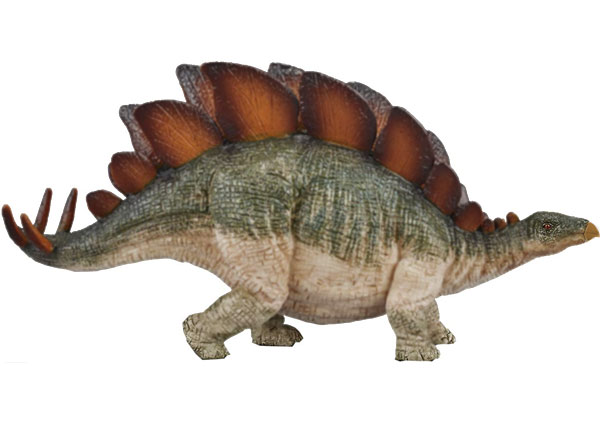
Stegosaurus was one of the most recognisable stegosaur dinosaurs that roamed western North America and Portugal during the Late Jurassic period, approximately 155 to 145 million years ago. This impressive herbivore measured up to 9 metres long and stood 3 metres tall at the hip, weighing around 5 tonnes. Its most distinctive features were the two rows of large, kite-shaped plates running along its back and the formidable spikes on its tail, known as a thagomizer.
As a plant-eater, Stegosaurus used its small, narrow head and beak-like mouth to crop low-growing vegetation such as ferns, mosses, and cycads. Its teeth were leaf-shaped and relatively weak, suggesting it may have swallowed stones to help grind food in its stomach. The dinosaur's front legs were notably shorter than its hind legs, giving it a distinctly arched posture that kept its head close to the ground for feeding.
Stegosaurus shared its Late Jurassic world with giant sauropods like Apatosaurus and Diplodocus, as well as the fearsome predator Allosaurus. The spikes on its tail served as a powerful defensive weapon against such threats, whilst the back plates may have been used for display, temperature regulation, or species recognition. Despite its armoured appearance, Stegosaurus was likely a relatively slow-moving animal, relying on its defensive features rather than speed to survive.
Remarkably well-preserved, over 80 individual Stegosaurus specimens have been discovered, making it one of the best-known dinosaurs. Three species are widely recognised: S. stenops, S. ungulatus, and S. sulcatus, primarily from the famous Morrison Formation of the American West.
Stegosaurus was instantly recognisable by its two parallel rows of large, diamond-shaped plates running along its back from neck to tail. Its tail bore four long, sharp spikes arranged in pairs, whilst its body had a distinctive arched profile with much shorter front legs than back legs.
Stegosaurus likely lived in herds and used its spiked tail as an active weapon, swinging it sideways at attackers in a behaviour called tail lashing. The plates on its back may have been brightly coloured for species recognition and social displays, and could potentially flush with blood for communication or thermoregulation.
Stegosaurus has appeared in numerous films including the 1933 King Kong and various Jurassic Park movies, and is featured in countless children's books and toys as one of the most beloved dinosaurs.
Stegosaurus was first described by Othniel Charles Marsh in 1877. The original fossils were discovered at Morrison Formation, Colorado, USA.