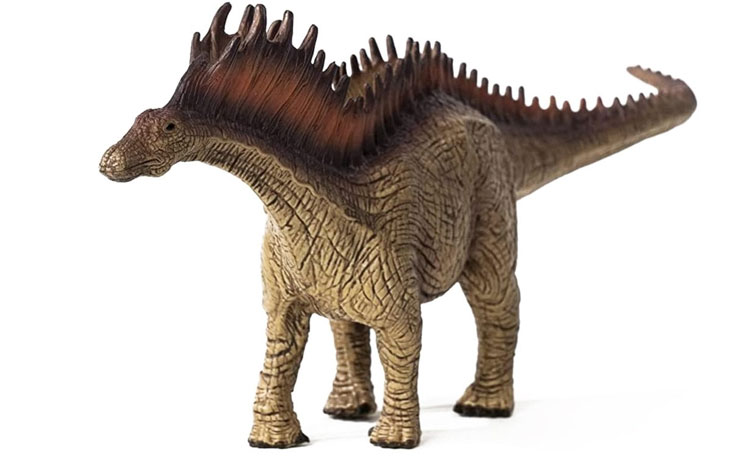
Amargasaurus Facts
Pronunciation: ah-MAR-ga-SORE-us
Name meaning: La Amarga lizard (named after the La Amarga Formation)
| Diet | Herbivore |
| Height | 3m |
| Length | 11m |
| Weight | 5 tonnes |
| Environment | Land |
| Era | Cretaceous |
| Period | Early Cretaceous |
| Type | Sauropod |
| Location | Argentina |
Amargasaurus was a remarkable sauropod dinosaur that lived during the Early Cretaceous period, approximately 126 million years ago, in what is now Argentina. Unlike its massive cousins, Amargasaurus was relatively small for a sauropod, measuring around 11 metres in length and standing about 3 metres tall at the hip. Despite its smaller stature, this dinosaur was one of the most distinctive long-necked giants ever discovered.
The most striking feature of Amargasaurus was the extraordinary double row of tall spines that ran along its neck and back. These spines were taller than those found on any other known sauropod and likely supported either a dramatic skin sail or individual keratinous sheaths. Scientists believe these impressive structures may have been used for display purposes, perhaps to attract mates or intimidate rivals, though they could also have served defensive functions.
As a herbivore, Amargasaurus fed on plants using its long neck to reach vegetation. However, its neck was notably shorter and less flexible than many other sauropods, suggesting it had a different feeding strategy. The dinosaur's relatively complete skeleton, including fragmentary skull remains, makes it one of the best-understood sauropods from its time period.
Amargasaurus lived in the lush, warm environments of Early Cretaceous South America, sharing its habitat with various other dinosaurs. Its unique appearance and well-preserved remains have made it an important species for understanding sauropod evolution and diversity during this crucial period in dinosaur history.
What made Amargasaurus distinctive?
Amargasaurus was distinguished by two parallel rows of exceptionally tall spines running along its neck and back, which likely supported either a skin sail or individual keratinous sheaths. It was also notably smaller than most sauropods, with a shorter, less flexible neck than its relatives.
Behaviour
Amargasaurus likely used its spectacular spinal display for communication with other members of its species, possibly during mating rituals or territorial disputes. Its shorter neck suggests it fed on lower vegetation than other sauropods, potentially reducing competition for food resources in its ecosystem.
Discovery
Amargasaurus was first described by Leonardo Salgado and José Bonaparte in 1991. The original fossils were discovered at La Amarga Formation, Neuquén Province, Argentina.
Amargasaurus FAQ
What did Amargasaurus eat?
Amargasaurus was a herbivore that fed on plants such as ferns, conifers, and early flowering plants. Its shorter neck compared to other sauropods suggests it specialised in feeding on lower-growing vegetation rather than tall tree tops.
How big was Amargasaurus?
Amargasaurus reached about 11 metres in length and stood approximately 3 metres tall at the hip, weighing around 5 tonnes. This made it quite small for a sauropod dinosaur, roughly similar in size to a large modern elephant.
When did Amargasaurus live?
Amargasaurus lived during the
Early Cretaceous period, approximately 125.77 million years ago. This was a time when flowering plants were beginning to diversify and many new dinosaur species were evolving.
Where was Amargasaurus found?
Amargasaurus fossils were discovered in the La Amarga Formation in Neuquén Province, Argentina. The single known skeleton was found in 1984 and represents one of the most complete sauropod specimens from South America.
How do you pronounce Amargasaurus?
Amargasaurus is pronounced 'ah-MAR-ga-SORE-us'. The name comes from La Amarga, the geological formation where it was discovered, combined with the Greek word 'saurus' meaning lizard.
What does Amargasaurus mean?
Amargasaurus means 'La Amarga lizard', named after the La Amarga Formation in Argentina where its fossils were discovered. The formation itself takes its name from a local geographical feature.
How fast could Amargasaurus run?
Like other sauropods, Amargasaurus was not built for speed. Its massive body and four-legged stance meant it likely moved at a walking pace of only a few kilometres per hour, similar to modern large elephants.
What type of dinosaur was Amargasaurus?
Amargasaurus was a sauropod dinosaur, specifically a member of the family Dicraeosauridae. Sauropods were the long-necked, plant-eating giants that included some of the largest land animals ever known.
Was Amargasaurus related to birds?
As a sauropod, Amargasaurus was not closely related to birds. Birds evolved from theropod dinosaurs, whilst Amargasaurus belonged to a completely different group of dinosaurs that were four-legged plant-eaters.
How many Amargasaurus fossils have been found?
Only one Amargasaurus specimen has been discovered, found in 1984 in Argentina. However, this single skeleton is remarkably complete, including rare skull fragments, making it one of the best-known sauropods from its time period.